“If the joints behind the disc are healthy, alignment is acceptable, and the segment is stable, Dr. Li will not recommend a fusion simply because ACDF is familiar.”
| Disc replacement | ACDF | |
|---|---|---|
| What replaces the disc? | A motion-preserving implant | A spacer plus plate; the bones heal into one |
| Neck motion at that level | Intended to continue | Intentionally stopped |
| Best when | One or two levels, preserved facets, no instability | Arthritic facets, deformity, instability, or revision |
| Adjacent discs | Spared the extra load a fusion can create | Take more motion over time |
| Typical stay | Same day or overnight | Same day or overnight |
The operations share a door
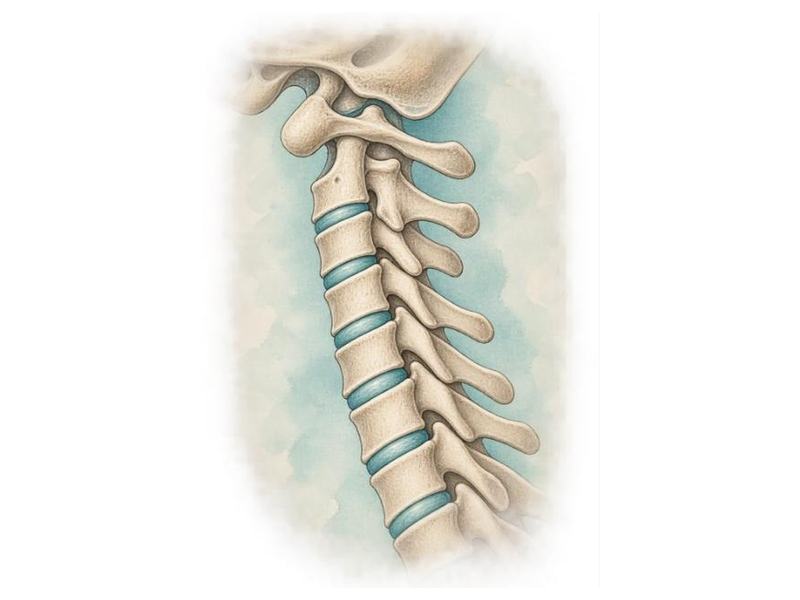
Anterior cervical disc replacement and anterior cervical discectomy and fusion (ACDF) start the same way. Through a small incision in a natural neck crease, the disc is removed, bone spurs are taken down, and the spinal cord or nerve is decompressed under the microscope. Patients often assume they are choosing between “surgery” and “no surgery.” By the time these two operations are on the table, the disc already needs to come out. The real question is what goes back in.
That is not a branding preference. It is a biomechanical one. A fusion locks two vertebrae together so the segment cannot buckle or collapse. An artificial disc is designed to keep bending and rotating after the diseased cushion is gone. Both can free a pinched nerve. Only one tries to leave the neck moving at that level.
When disc replacement is the plan
Disc replacement is one of Dr. Li’s defining operations. He trained with Daniel Riew at Columbia, a pioneer of cervical arthroplasty, and uses microscope-assisted replacement as a primary option for one- or two-level herniation or degeneration when the facet joints behind the disc are still reasonable, the neck is not collapsing into kyphosis, and the segment is not already unstable.
The case for motion is practical. Adjacent discs do not have to pick up the extra work a fused level used to do. Many people return to desk work within two weeks. A soft collar, if used at all, is for comfort — not a months-long restriction while bone knits.
Wanting to keep motion is not vanity. Looking over a shoulder, backing a car, and working at a screen are daily cervical jobs. If an implant can treat the compression without taking those jobs away, fusion is not the first recommendation.
When ACDF is the honest answer
Fusion remains the right reconstruction when the joints behind the disc are badly arthritic, when alignment must be changed, when the segment is already unstable, or when the level has been operated on before and the anatomy no longer supports an implant. In those settings a moving disc would sit on a worn hinge. That is not motion preservation. That is a mechanical mismatch.
ACDF is also the workhorse for selected deformity and for patients whose bone quality, anatomy, or goals make an arthroplasty unwise. Dr. Li studies the details that affect whether a fusion actually heals — cage subsidence, screw size, sarcopenia, whether an ENT evaluation is warranted before revision ACDF — because a “routine” fusion is only routine when the plan is right.
He will not refuse fusion out of ideology. He will not recommend it because it is the operation everyone learned first.
Hybrids, instead of fusing the whole neighborhood
Some necks need both. One level may have destroyed facets; the next may be a clean herniation in a still-mobile joint. A hybrid — fusion at the level that cannot move honestly, disc replacement at the level that still can — is often a better reconstruction than fusing everything in sight.
That is the same philosophy written at a smaller scale: keep what can be kept. Stabilize what cannot. Do not spend motion you do not have to spend.