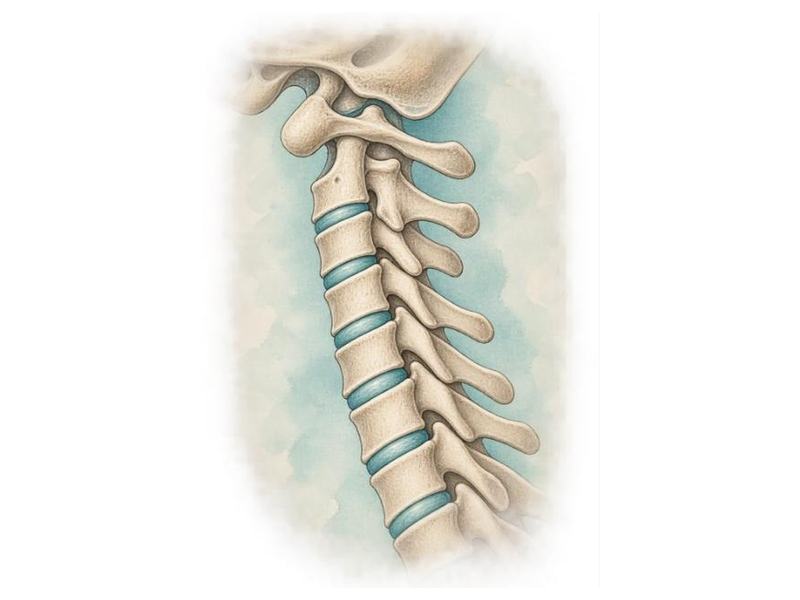
“For multilevel cervical stenosis with a lordotic neck, laminoplasty is preferred so the cord can have room without sacrificing rotation. Fusion is used when the neck must be held still for healing — not as the default for a tight canal.”
| Laminoplasty | Posterior fusion | |
|---|---|---|
| Goal | Give the cord room; keep motion | Decompress if needed, then lock selected levels |
| Typical problem | Multilevel stenosis with myelopathy, lordotic neck | Instability, kyphosis, trauma, tumor, or backing up an anterior construct |
| Neck rotation | Intended to remain | Reduced across the fused levels |
| Incision | Posterior (back of the neck) | Posterior |
| Collar | Motion encouraged as pain allows | Often used while the fusion consolidates |
Myelopathy is a cord problem
Cervical myelopathy is compression of the spinal cord in the neck — clumsy hands, a sense of walking on foam, dropping objects, handwriting that has quietly gotten worse. It is not a pinched nerve that will “settle.” Waiting can allow permanent injury. The operation, when it is needed, is chosen to protect the cord. Pain relief is welcome. Cord protection is the point.
Two posterior operations are often confused because both use a back-of-neck incision. Laminoplasty hinges the lamina open like a door and holds it there so the cord can float backward. Posterior cervical fusion places screws and rods so selected levels cannot move while bone heals. One is a decompression that keeps motion. The other is a stabilization. Using the second as a default for the first is how people lose rotation they did not have to lose.
When laminoplasty is the preferred door
Laminoplasty is how Dr. Li decompresses a tight cervical canal across several levels without an automatic fusion. It is a signature motion-sparing technique alongside cervical disc replacement. The anatomy has to cooperate: the neck should still have lordosis (a backward curve) so that when the door opens, the cord can drift into the new space rather than remaining draped over a kyphotic hill.
Patients with multilevel stenosis, myelopathy, and a reasonably aligned neck are often better served by this than by a long fusion from the front or the back. Hand function and gait recover over weeks to months as the cord quiets. Therapy is aimed at the functions myelopathy had been stealing — buttons, balance, fine motor — not at locking the neck in a rigid collar for a season.
When the neck must be held still
Posterior fusion is the honest reconstruction when the neck is unstable, fractured, involved by tumor, or falling into kyphosis that a hinged door cannot fix. It is also used to back up a long anterior reconstruction so the column does not fail at the back. Those are biomechanical problems. Motion preservation does not treat them.
A herniated disc that pinches one nerve is not, by itself, a reason for posterior fusion. Dr. Li uses this operation when the mechanics require it, and not as a substitute for laminoplasty, disc replacement, or a foraminotomy that would have been enough.
Front, back, or both
Some patterns of compression sit in front of the cord — a collapsed disc, a ridge of bone behind the vertebral body. Those may need an anterior operation (disc replacement, ACDF, or corpectomy) instead of, or in addition to, a posterior door. Laminoplasty is not a universal myelopathy procedure. It is the right posterior one when the canal is tight across several levels and the neck’s shape will let the cord take the extra room.
The conversation in clinic is about that shape, the number of levels, and what the patient still needs the neck to do. It is not about which incision looks more familiar on an old textbook page.