UVA Health · New patients

General

Herniated disc

A herniated disc is the soft inner nucleus (the “jelly”) pushing through a tear in the outer annulus (the “ring”). Endplates sit above and below the disc.

Think of the disc as a jelly doughnut between two bones. The nucleus pulposus is the jelly. The annulus fibrosus is the ring. Cartilaginous endplates are the top and bottom of the doughnut, where the disc meets bone.
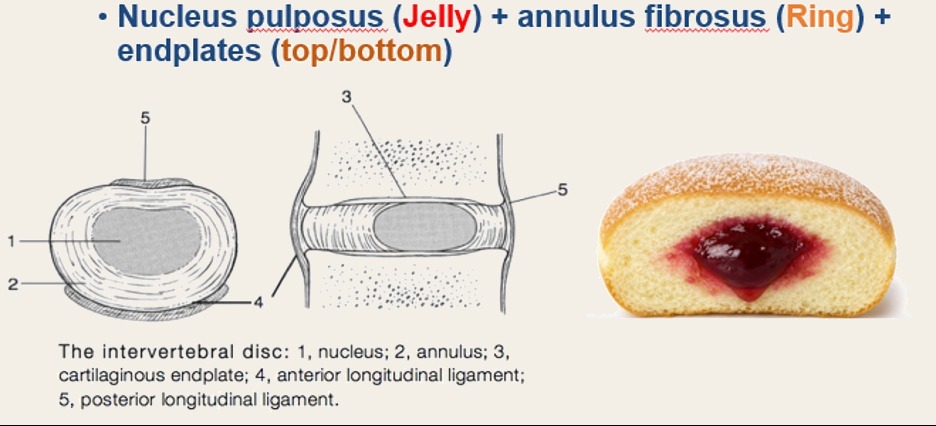
Diagram of the intervertebral disc beside a jelly doughnut: nucleus, annulus, and endplates
Nucleus pulposus (jelly) + annulus fibrosus (ring) + endplates (top/bottom). The doughnut is a teaching analogy, not a surgical image.

On a standard drawing of the intervertebral disc: (1) nucleus, (2) annulus, (3) cartilaginous endplate, (4) anterior longitudinal ligament, (5) posterior longitudinal ligament.

A herniation is the jelly escaping through a tear in the ring and irritating a nearby nerve — often causing arm or leg pain, numbness, or weakness. Most herniations settle with time, therapy, and selected injections. Surgery is considered when pain persists, strength is declining, or walking and bladder function are affected.

When an operation is needed, Dr. Li favors the smallest effective one — tubular microdiscectomy or ULBD when decompression alone is enough, and motion-preserving disc replacement when the disc itself must be replaced.

Lecture

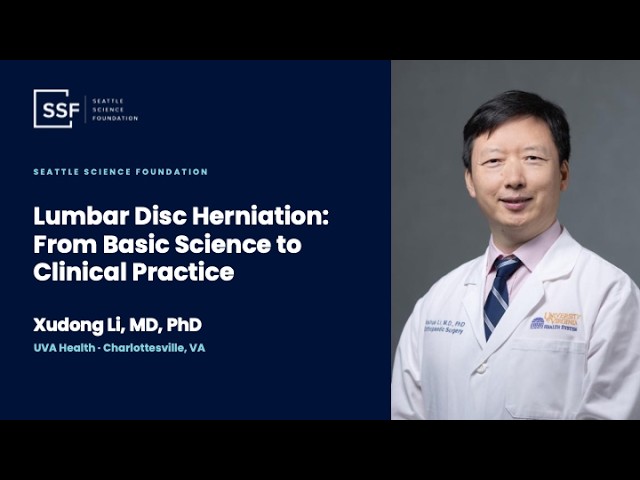
Lumbar Disc Herniation: From Basic Science to Clinical Practice

Seattle Science Foundation

Watch on YouTube: Lumbar Disc Herniation: From Basic Science to Clinical Practice

Click the lecture to watch on YouTube.

FAQ

About herniated disc

What is herniated disc?

A herniated disc is the soft inner nucleus (the “jelly”) pushing through a tear in the outer annulus (the “ring”). Endplates sit above and below the disc.

What are symptoms of herniated disc?

Radiating arm or leg pain (radiculopathy); Numbness or tingling in a specific pattern; Weakness in a muscle group; Pain that worsens with sitting, coughing, or bending.

How does Dr. Li treat herniated disc?

When an operation is needed, Dr. Li favors the smallest effective one — tubular microdiscectomy or ULBD when decompression alone is enough, and motion-preserving disc replacement when the disc itself must be replaced.

Appointments

Ready to take the next step toward recovery?

New patients are welcome. Call the spine clinic or send a note — the team will help you find the right visit.