“Fusion is recommended when the segment cannot safely move, when alignment must be changed, or when the bone itself is the disease. It is not recommended because fusion is the default operation of a generation ago.”
| Keep motion | Fuse | |
|---|---|---|
| Joints and disc | Facets reasonable; disc can be replaced or left | Facets destroyed, disc collapsed, segment unstable |
| Alignment | Acceptable; no need to change the shape | Kyphosis, scoliosis, or flatback that must be corrected |
| The bone itself | Intact | Fracture, tumor, or infection involving the column |
| Goal | Decompress; let the level keep working | Decompress if needed; make a stable shape the person can live in |
The philosophy is not “never fuse”
Dr. Li’s public rule is easy to misread as anti-fusion. If a motion-preserving procedure can treat the condition, fusion is not recommended. If a minimally invasive decompression can fix the problem, a long open incision is not chosen. The second half of that rule matters as much as the first: when those conditions are not true, the honest operation is the one that solves the mechanical problem — even if it is larger, even if it takes motion away.
Fusion is how a spine is made into a stable shape. It is the foundation of adult scoliosis reconstruction, of many trauma operations, of tumor reconstruction after a vertebral body is removed. Refusing it on principle would leave people with cords at risk and with postures they cannot stand in.
Destroyed joints, unstable segments
An artificial disc sitting on arthritic facets is not motion preservation. A decompression on unstable spine is not a small victory — it is an incomplete one. ACDF, posterior cervical fusion, TLIF, ALIF, and OLIF exist because some levels have already used up their right to move.
Revision surgery after a prior operation often lands in this category. Scar, missing bone, and changed alignment narrow the list of reconstructions that will hold. Fusion is frequently the durable answer there, sometimes combined with a motion-preserving level next door as a hybrid rather than as a slogan.
Alignment is not cosmetic
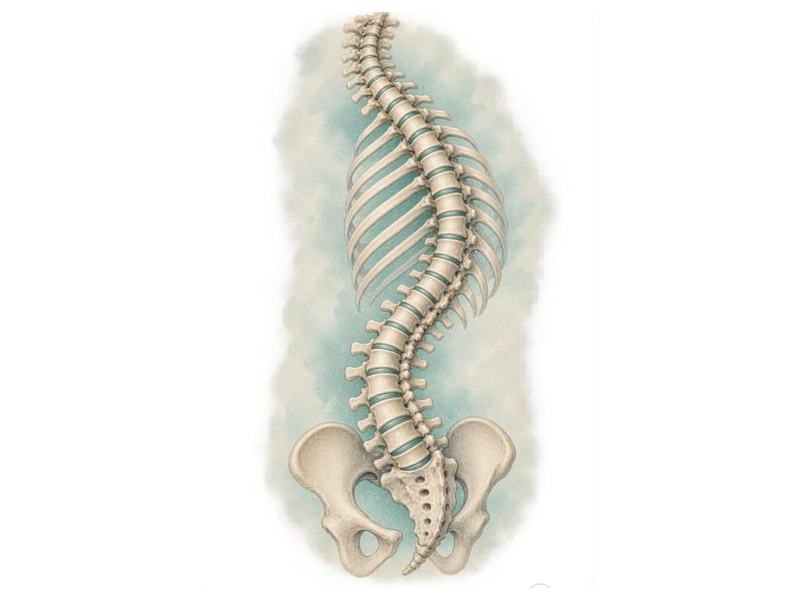
Scoliosis, kyphosis, and flatback are not x-ray hobbies. They are reasons people cannot stand, cannot see the horizon, or pay for posture with the next disc in line. Reconstruction is designed so the patient can walk and look ahead — not so a film looks straight at any cost. That reconstruction uses fusion on purpose. The levels that must change shape are the levels that are fused. The levels that can still share motion are not fused for company.
Dr. Li has published on risk after complex adult deformity surgery because these operations have real risk, and the consent should be as honest as the x-ray is ambitious. Choosing fusion in deformity is not a failure of the motion-preserving program. It is the program applied to a different problem.
Tumor, trauma, and the bone itself
When the disease is the vertebral body — burst fracture, tumor, selected infection — the column has to be rebuilt. Corpectomy, struts, cages, and posterior rods are fusion language because the missing bone has to become a stable one. Motion implants do not replace a destroyed vertebra.
The clinic question is always the same, whether the MRI shows a herniated disc or a three-dimensional curve: what is the mechanical problem, and what is the smallest reconstruction that actually solves it? Sometimes that reconstruction is a tube the width of a finger. Sometimes it is a fusion from the lower thoracic spine to the pelvis. Both can be honest. Only one is honest for a given spine.