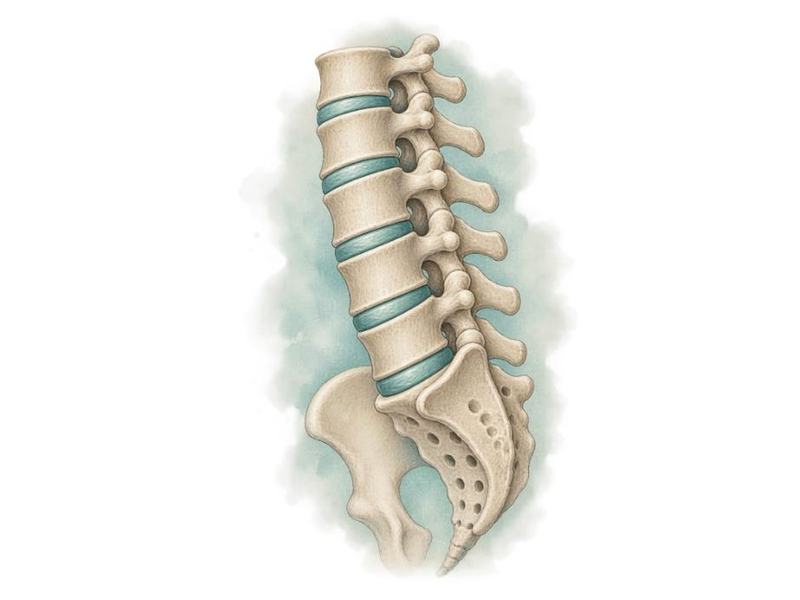
Dr. Li’s rule is consistent: motion first, and the smallest operation that solves the problem. Fusion is part of the practice when the segment has already used up its right to move. Educational information, not a personal recommendation.
What symptoms require evaluation?
Pain alone is a reason to be seen if it has lasted, if it wakes you, or if it is changing your walking. Evaluation is more urgent when there is a neurologic story: arm or hand clumsiness, dropping objects, a shopping-cart stoop that lets you walk farther, radiating pain in a clear nerve pattern, or new imbalance. Those patterns point to disc herniation, stenosis, myelopathy, or a slip— not to “a bad back” as a personality trait.
When conservative treatment is reasonable
A first episode of neck or back pain, a herniated disc without progressive weakness, and stenosis that still allows a useful day often deserve time. Activity modification, anti-inflammatory medicine if your other doctors agree it is safe, and a short course of physical therapy are not delays — they are a test of whether the nerve can settle. Imaging can wait if the neurologic exam is stable and the story is days to a few weeks old. Surgery is not a prize for having suffered long enough; it is considered when the underlying problem is unlikely to resolve on its own and is limiting function, causing neurologic problems, or threatening the stability of the spine.
When injections and physical therapy may be appropriate
Therapy that restores walking, hip extension, and scapular control can change how a compressed nerve is loaded. An epidural or nerve-root injection can calm inflammation enough to make therapy possible. It does not enlarge a canal or put a disc back in place. If three or four months of honest conservative care have not changed function — walking distance, hand use, sleep — the injection has already given its answer.
When surgery becomes reasonable
Surgery is reasonable when the films match the person in the room, and when the limitation is mechanical: a disc fragment occupying the foramen, a canal so tight that walking stops at a block, a cord flattened from the front and the back, or a curve that is throwing the head and pelvis out of plumb. It is also reasonable when weakness is worsening, or when a person has already done the conservative work and still cannot live their day. An MRI without a matching story is not an indication.
When postponing surgery is safe
Surgery can often wait when neurologic function is stable — no progressive weakness, significant imbalance, worsening numbness, hand clumsiness, or other signs of spinal cord dysfunction. Pain can mean that a nerve is irritated without being permanently damaged. If function is stable, the timing of surgery can follow how much the pain affects daily life and personal goals. A concerning MRI does not, by itself, mean surgery now.
When urgent evaluation is needed
Do not wait for an elective spine visit if you have new loss of bladder or bowel control, numbness in the saddle area, rapidly worsening weakness in the arms or legs, or a sudden inability to walk. Those are emergency-department problems. Progressive myelopathy — clumsy hands, a changing gait over days to weeks — should be seen promptly in clinic, not “watched” for another season.
How Dr. Li evaluates surgical options
The visit is a matching exercise. History and exam first. Then standing x-rays if posture or a slip is in the story, and an MRI that is recent enough to be the same disease. Flexion-extension films when stability is the question. The operation is chosen to treat the compression, the instability, or the deformity that is actually there — not the one that is easiest to instrument. See how Dr. Li chooses treatment for the six decision pages patients search most.
When motion preservation is possible
If the joints still work and the spine is stable, keeping motion is usually the smaller long-term problem. Cervical disc replacement instead of an automatic ACDF. Laminoplasty instead of a long posterior fusion when the neck is still lordotic. ULBD instead of fusion for stenosis, including some grade 1 slips, when decompression can be done without taking down the posterior tension band. Those choices are spelled out in disc replacement vs ACDF, laminoplasty vs fusion, and ULBD vs fusion.
When fusion is appropriate
Fusion is the honest operation when the segment is unstable (including grade 2 or greater spondylolisthesis), when the facets are already destroyed, or when lordosis and pelvic alignment have to be rebuilt. An artificial disc on arthritic joints is not motion preservation. A decompression on an unstable spine is an incomplete operation. That is the subject of when fusion is the answer, and of adult scoliosis reconstruction when the curve — not a single disc — is the disease.
How to obtain a second opinion
If fusion has already been recommended, a second look is not disloyalty. It is how you find out whether the construct is required, or whether a motion-preserving operation still treats the compression. How a second opinion works: call 434.243.3633, bring (do not email) a recent MRI and the other surgeon’s note, and use UVA MyChart or a hospital share for the images. This website does not store medical records.
Educational information, not medical advice. Treatment is decided after an in-person evaluation at UVA Spine Care.